There are two kinds of people who call us about a safe. The first is dealing with something urgent: a combination that stopped working, a keypad that went dead, a key that broke off inside the lock. They need access today, sometimes right now, and every hour that passes is costing them something, whether that is cash they cannot get to, documents they need, or a firearm they cannot secure properly.
The second type is in less of a hurry but equally stuck: they inherited a safe from a family member, bought a property that came with one, or simply cannot remember a combination they set years ago and never needed until now.
Both situations are completely normal, both have straightforward solutions, and neither requires destroying the safe to resolve. What they both require is someone who understands how safe locking mechanisms actually work and knows how to choose the right opening method for the specific lock in front of them.
At MLine Locksmith, we provide professional safe openings for residential and commercial clients throughout the Main Line, Chester County, and Delaware County. We prioritize non-destructive techniques whenever the situation allows, and we restore full functionality after every opening. Every job is backed by a 1-year warranty on parts and labor.
This is the most important thing on this page, and it is worth saying clearly: attempting to force a safe open before calling a professional almost always makes the situation worse and more expensive to resolve.
Safe manufacturers design their products to resist forced entry, which means that common improvised approaches, prying at the door, hammering the keypad, repeatedly entering wrong combinations hoping to trigger a reset, tend to damage the boltwork or locking mechanism rather than bypass it. A safe that could have been opened through manipulation in thirty to forty-five minutes becomes a drilling job after someone has spent an hour working on it with the wrong tools. A boltwork system that was intact becomes jammed and bent. An electronic keypad that might have responded to a battery reset gets damaged beyond recovery.
We are not saying this to be discouraging. We are saying it because the clients who call us after attempting their own solution consistently end up paying more and waiting longer than they would have if they had called first. If your safe is locked and you cannot open it, the most cost-effective thing you can do is stop and make the call.
The question every client asks first is whether their safe is going to be damaged during opening. The honest answer is that it depends on the lock type, the condition of the mechanism, and whether any prior attempts at forced entry have complicated the situation.
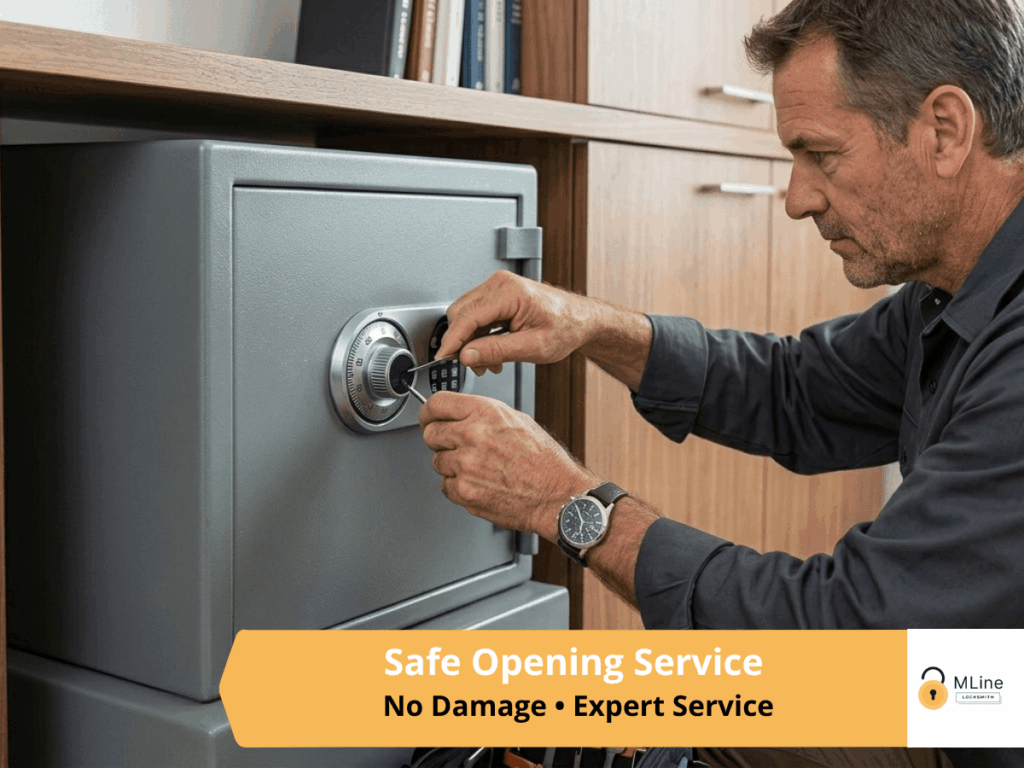
Non-destructive opening through manipulation is always our first approach when it is viable. For mechanical dial locks, this involves working through the combination sequence using knowledge of how the internal wheel pack is aligned, a process that requires patience and experience but leaves the safe completely intact. For electronic keypads, we start with diagnostic steps: battery checks, reset procedures, and bypass methods that vary by manufacturer. Many electronic safe lockouts that seem serious resolve quickly once the right diagnostic steps are applied in the right order.
Drilling becomes necessary when manipulation is not viable, which happens when the internal mechanism has been damaged, when the lock is a high-security design specifically built to resist manipulation, or when prior attempts at forced entry have compromised the boltwork in a way that no longer allows a clean mechanical approach. When we drill, we do it at manufacturer-recommended entry points using the right tooling for the specific safe model, which minimizes damage and preserves the structural integrity of the door and body.
The important thing to understand is that drilling does not mean the safe is ruined. It means we made a controlled, precise entry at a specific point that can be repaired afterward.
Safe opening is only half the job. Once we have access, we assess what the lock and mechanism need and restore the safe to full working condition before we leave.
For mechanical locks, this may mean resetting the combination to one you choose, replacing worn internal components, or installing a new lock cylinder if the original was beyond repair. For electronic safes, it may mean replacing a failed keypad, swapping out a circuit board, or reconfiguring the system with a new master code. If drilling was necessary, we repair the drill site and replace the lock so the safe is fully functional and secure again.
Clients are often surprised by this part of the process. Many assume that once a safe is opened the hard way, it is effectively done as a security device. That is not the case when the work is done properly. A professionally opened and repaired safe is a working safe.
We work with the full range of residential and commercial safe types: fireproof document safes, gun safes, wall safes, floor safes embedded in concrete, drop safes and depository safes, cash safes, and higher-security vault-style commercial units. We handle mechanical dial locks, electronic keypads, key-operated locks, and combination systems.
The variety of safe types matters less than the experience of the technician in front of it. A locksmith who has worked on hundreds of safes across different brands and locking mechanisms reads a situation differently than someone approaching it for the first time. We have opened safes across properties in West Chester, Media, Newtown Square, Wayne, and throughout the surrounding area, and that breadth of field experience is what allows us to make the right call on approach quickly.
For homeowners, the most common scenarios we handle are forgotten combinations on safes that have not been opened in years, electronic keypads that stopped responding, and safes inherited from family members with no documentation of the combination or key. We also regularly assist with gun safe access, which carries its own urgency when firearms need to be secured or retrieved.
The contents of a safe are almost always irreplaceable in some form, whether financially or personally. Important documents, jewelry, family records, firearms, cash. We treat every residential opening with the corresponding level of care, which means working methodically, communicating clearly about what we are doing and why, and making sure the safe is fully functional before we close out the job.
Our residential locksmith services extend beyond safes to cover the full range of home security needs, so if you have other lock or security concerns while we are on-site, we can address those in the same visit.
For businesses, a locked safe is almost always an operational problem. Cash that needs to be counted, payroll that needs to be processed, documents that need to be accessed. Downtime has a direct cost, which is why we treat commercial safe calls with particular urgency during our operating hours.
Commercial safes tend to be higher-security units than residential ones, which means the opening process may take longer and require a more specialized approach. Drop safes and depository safes have their own specific locking configurations. High-security cash safes often have time-delay mechanisms or relocker systems that activate when certain tampering conditions are met. We assess the specific unit before committing to a method and communicate clearly on timeline and cost before starting work.
If your business is in Devon, Ardmore, Malvern, Exton, West Chester, or anywhere across the Main Line and surrounding counties, our commercial locksmith team handles safe openings as part of a broader range of commercial security services.
We verify ownership or authorization before opening any safe. This is a standard professional practice, not an interrogation, and for anyone with a legitimate need it is a straightforward process.
For residential clients, we typically ask for a photo ID and some form of documentation connecting you to the property or the safe itself, a deed, a lease, or similar. For inherited safes, a death certificate and documentation of the estate or relationship is generally sufficient. For commercial clients, authorization from a business owner or manager covers the situation in most cases.
We mention this not to create obstacles but because clients sometimes worry that this process will be complicated or invasive. It is not. We handle it practically and without judgment. Our only interest is confirming that the person requesting access has a legitimate right to it, which protects both the client and us.
A few straightforward practices significantly reduce the chance of ending up in this situation again.
For electronic safes, the single most effective step is replacing the batteries annually on a set schedule, even if the safe appears to be working fine. Battery failure is the most common cause of electronic safe lockouts, and it almost always happens at an inconvenient moment because low batteries tend to fail under load, meaning the safe may appear fine until the exact moment you try to open it. Set a calendar reminder and change the batteries every twelve months regardless.
For mechanical combination locks, store the combination somewhere separate from the safe itself, ideally in a secure location outside the property. A combination stored in the same place as everything else you are trying to protect defeats the purpose.
If your mechanical dial has started feeling inconsistent, stiffer than usual, or requires more precision than it used to, that is an early sign of internal wear worth addressing before it becomes a lockout. A dial that is slightly off can be serviced and recalibrated before it fails completely, which is considerably less expensive than an emergency opening.
Licensed & insured locksmith serving Chester County and Delaware County, PA.
We prioritize non-destructive methods in every case. If drilling is necessary, we do it precisely at the appropriate entry point and repair the site afterward so the safe is fully functional. We do not treat drilling as a first resort or as an excuse to do sloppy work.
A straightforward electronic lockout resolved by battery replacement or reset can take under thirty minutes. A mechanical manipulation job on a standard residential safe typically takes between thirty minutes and an hour and a half. High-security commercial safes and situations complicated by prior forced entry attempts can take longer. We give you an honest estimate after assessing the specific unit.
Yes. Combination reset and lock reconfiguration are standard parts of the service after opening. We can set a new combination of your choice or configure a new electronic access code depending on the lock type.
This is a common situation and there is a reasonable verification process for it. Bring what documentation you have connecting you to the estate or property and we work through it from there. Call us first and we can tell you exactly what to bring.
Yes. If a safe was previously drilled and never properly repaired, we can assess the damage, replace the lock, and restore it to working condition.
We provide safe openings during our regular business hours, 7AM to 11PM seven days a week. We are not a 24-hour service. If your situation is urgent, call as early in the day as possible so we can get to you without delay.
A locked safe is a solvable problem. Whether the issue is a forgotten combination, a failed electronic keypad, a broken key, or a safe that has been sitting locked in a property for years, there is a professional path to access that does not require destroying what you are trying to protect.
At MLine Locksmith, every safe opening is performed by licensed and insured locksmiths who take the repair and restoration side of the job as seriously as the opening itself. Our work is backed by a 1-year warranty on parts and labor.
If you are locked out of a safe anywhere across the Main Line, Chester County, or Delaware County, give us a call and we will talk through the situation before you try anything else.