
When it comes to exit doors, commercial buildings have one non-negotiable requirement: people need to be able to get out quickly and without thinking. Panic bars make that possible. They also prevent unauthorized people from entering through the same door, which is why the correct hardware and installation are as important as the hardware itself.
At MLine Locksmith, we install, repair and replace panic bars and exit devices for commercial properties across the Main Line, including Wayne, Berwyn, Devon, Malvern, Paoli and Villanova. Whether you are fitting out a new office in Berwyn, upgrading aging hardware in a Paoli warehouse or bringing a Wayne retail space up to code, we handle the entire installation process from assessment to final testing.
We are licensed and insured. We offer a 1-year warranty on parts and labour.

Panic bars aren’t just a safety best practice. For most commercial properties, they’re a legal requirement.
The International Building Code (IBC) and the NFPA 101 Life Safety Code require panic hardware on exit doors in buildings that meet certain occupancy thresholds. In Pennsylvania, this applies to:
– Assembly spaces with an occupant load of 50 or more;
– High-hazard occupancies, regardless of size;
– Educational facilities;
– Healthcare facilities;
– Any door serving as a required means of egress in applicable occupancy types.
If your building has been flagged during an inspection, or if you are preparing for one, the fastest way to resolve the issue is to get the right hardware installed correctly. We are familiar with what inspectors look for in properties in Chester County and Delaware County and can help ensure your installation meets their expectations.
Not all panic bars are suitable for all doors. The right choice depends on the type of door, the security requirements and whether the hardware needs to integrate with an access control system. Here’s how to think about it:
Rim exit devices are the most common type for standard single commercial doors. Rim devices are mounted on the surface of the door, making them straightforward to install and maintain. They are a good fit for retail stores, small offices, and side exits in most commercial buildings.
Vertical rod exit devices secure the door at both the top and bottom simultaneously, making them significantly more resistant to forced entry. They are the right choice for double doors, high-traffic exits and any application where a rim device does not provide enough security. They are common in schools, government buildings, and healthcare facilities.
Mortise exit devices integrate directly into the door body rather than being surface-mounted. This results in a cleaner appearance and greater durability under heavy use. They are used in institutional buildings, higher-end office properties, and anywhere where both aesthetics and longevity matter.
Electrified panic bars connect directly to your access control system, controlling who enters while still permitting free exit at all times. Depending on your system, credentials can be key cards, fobs, PIN codes, or mobile credentials. They are the right choice for any door that requires both emergency exit and controlled entry, such as server rooms, restricted areas and multi-tenant building entrances.
If you’re not sure which type is right for you, we can assess the door and provide a clear recommendation before any work begins.
The requirements and usage patterns of panic bars vary significantly by property type. Here’s how we approach each one:
Wayne and Berwyn have a high concentration of professional office buildings, many of which were built or last renovated decades ago. Aging rim devices are commonplace, and there is an increasing demand for electrified hardware to be integrated with modern access control setups. We handle both straightforward replacements and full access control tie-ins.
Retail properties usually require coverage of rear stockroom doors and emergency side exits, as well as the front entrance. We assess all required exit points, not just the obvious ones.
Clinics and medical offices along the Route 30 corridor have specific requirements regarding controlled access and heavy door traffic. We install durable hardware that is rated for high-cycle use, and we can integrate it with existing keycard or fob systems.
Schools in the Radnor, Great Valley and Unionville-Chadds Ford districts often require panic hardware for gymnasium exits, cafeteria doors and secondary building entrances. We have experience with the egress requirements specific to K-12 properties in Pennsylvania.
Large-occupancy facilities require robust hardware that can withstand daily wear and tear. We specify and install heavy-duty devices rated for industrial use, including vertical rod systems on wide bay doors.
Common area exits, basement doors and parking garage entries all require proper egress hardware. We work with property managers across the Main Line to ensure these doors are compliant and well-maintained.
We evaluate each door individually, taking into account factors such as the material, frame condition, existing hardware, traffic volume and whether the opening is fire-rated. This step determines which device is compatible and what preparation the door requires prior to installation.
Based on the assessment, we will recommend a specific device to fit your door that meets your security and compliance requirements. We will explain the options clearly before you commit to anything.
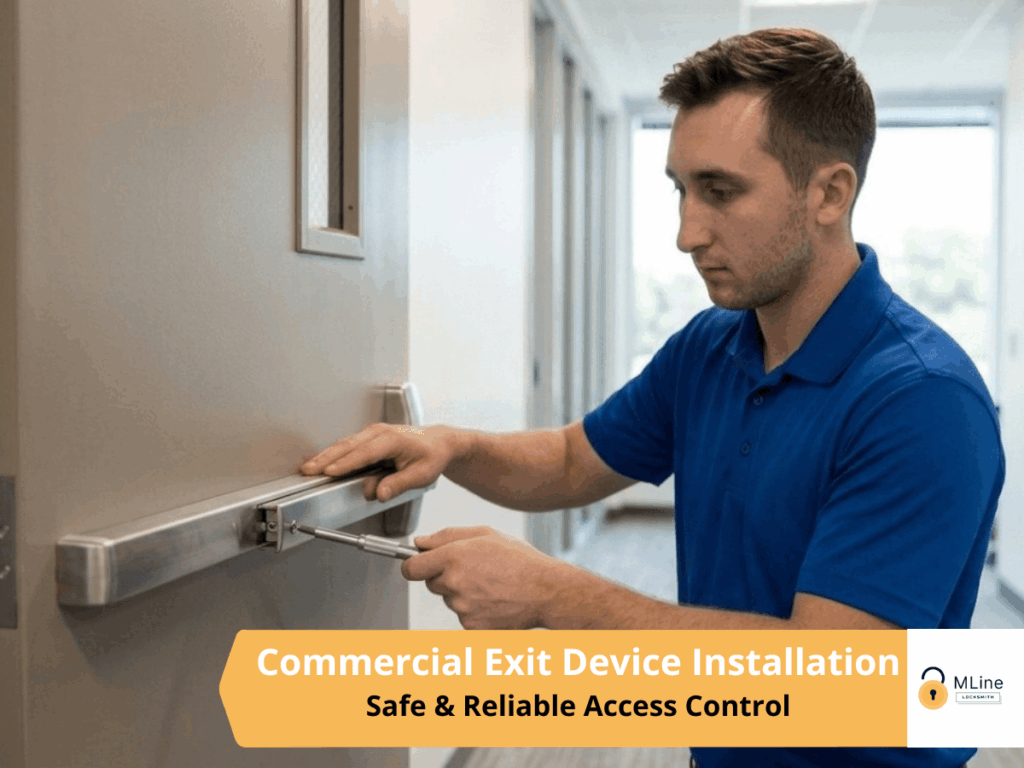
Proper alignment is what ensures a panic bar works reliably for years rather than sticking, mislatching or wearing out prematurely. We will fit the device, align the strike and make any necessary adjustments to the door frame.
If the device is electrified, we will connect and configure it to work with your existing access control system. This includes testing credential readers, request-to-exit sensors and door monitoring connections.
Before we leave, we test every function, including exit operation, latch engagement, outside entry (if applicable) and alarm integration. Nothing is signed off until everything works exactly as it should.
Not every issue necessitates a complete replacement. Many issues with panic bars can be resolved with targeted repairs, which are less expensive and get the door back into service more quickly.
– Stiff or sticky push bars that require excessive force
– Broken or bent latch bolts
– Misaligned strikes causing incomplete latch engagement
– Loose or damaged mounting hardware
– Worn dogging mechanisms
– The device is severely corroded or physically damaged.
– Replacement parts are no longer available for older models.
– You are upgrading from a standard device to an electrified one.
– A building renovation or expansion changes the door’s requirements.
We will always give you an honest assessment of whether repair or replacement is the best option. If a repair will last for years, we will tell you.
Fire-rated doors require special attention. The panic hardware installed on a fire-rated opening must be fire-rated itself and compatible with the door’s rating. Installing non-rated hardware on a fire-rated door can void the door assembly’s certification and create a liability issue.
We check the door label before specifying any hardware for fire-rated openings, installing only listed devices that maintain the opening’s rating. This is important for both compliance and insurance purposes.
Licensed & insured locksmith serving Chester County and Delaware County, PA.
Panic hardware is likely required under the IBC and NFPA 101 if your building has an assembly, educational, healthcare, or high-hazard occupancy, or if any exit door serves an area with 50 or more occupants. Your local building or fire inspector can confirm the specific requirements for your property. We can also assess your doors and provide practical advice on what is needed.
In most cases, yes. Standard commercial steel doors and hollow metal frames are compatible with a wide range of panic hardware. However, wood doors and some aluminium storefront systems require specific devices or additional preparation. We will identify any such issues during the assessment.
Electrified panic bars can integrate with most modern access control platforms. Whether this is possible depends on the specifications of your existing system, which we will review before recommending any hardware. For properties without access control, we can discuss options for adding it alongside the installation of the panic bar. Please see our access control installation page for more details.
Installing a single door with a standard rim device typically takes one to two hours. Vertical rod and mortise installations take longer, especially if the door needs to be prepared. Electrified devices with access control integration require additional time for wiring and configuration. For multi-door projects, we will provide a timeline following the initial assessment.
Yes. Periodic inspection and lubrication extend the life of the hardware and prevent problems from causing failure. We recommend checking doors in regular use at least once a year, and more frequently for high-traffic exits.
Hours: 7 am to 11 pm, every day
We are licensed and insured. We offer a 1-year warranty on parts and labour.